A deterministic system of record for technology capital.
Deterministic Technology Capital Ledger
Deterministic Financial Output
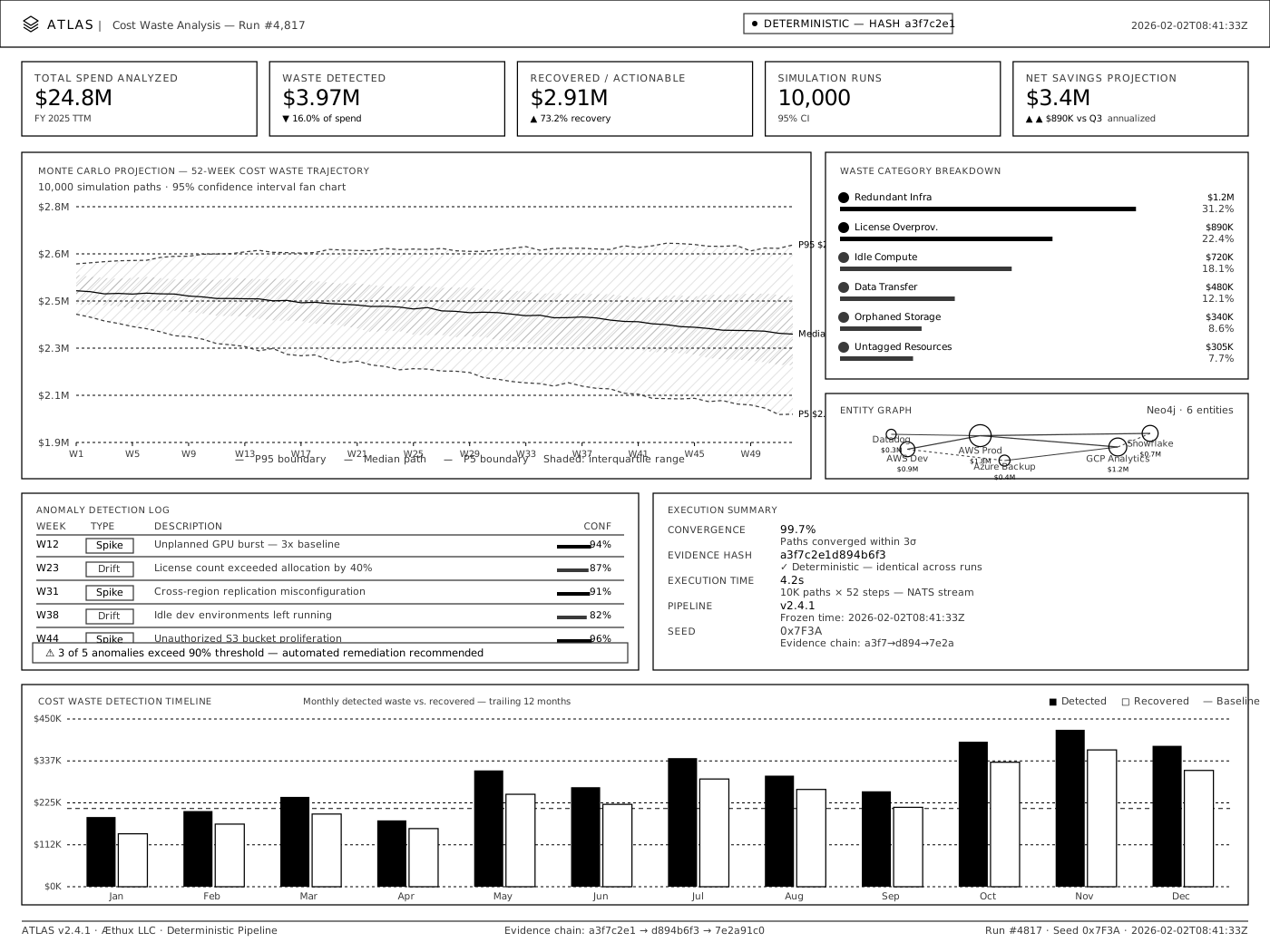
Deterministic Technology Capital Ledger
Technology is often one of the largest operating expenses, yet it remains one of the least modelable. Multi-year commitments are approved without quantified downside exposure. Vendor concentration builds quietly past 10 percent of stack dependency. Margin moves but the drivers cannot be isolated to a replayable system of record. Leadership turns over while financial obligations persist and ownership fragments across teams.
CFOs are expected to underwrite capital with precision. Technology rarely meets that standard. There is no deterministic ledger tying dollars to operational reality, no unit economics at the system level, and no scenario engine to quantify exposure before change is approved. Without that, decisions rely on narrative rather than math.
Atlas was engineered under live enterprise conditions alongside C-Suite leaders responsible for nine-figure technology estates. The mandate was explicit: technology capital is too large, too complex, and too politically sensitive to be governed by intuition, spreadsheets, or delayed reporting. It requires computable assurance.
The architecture binds financial entitlements to operational reality through deterministic reconciliation, canonical identity resolution, and a replayable execution ledger. Every output is traceable to source evidence. Every scenario can be re-run under identical inputs. The result is capital certainty, not advisory narrative.

Technology capital now carries concentration and systemic exposure comparable to financial markets, aerospace programs, and energy grids. Atlas applies disciplines proven in environments where failure is unacceptable and capital density is extreme.

Quantitative finance — thousands of simulations are required to price variance and tail risk under volatile conditions.
Aerospace engineering — digital twins model years of stress before a single physical commitment is made.
Energy grid operations — operators simulate cascading load scenarios to prevent systemic failure.
Most enterprise tooling only sees what is tagged, billed, or manually declared. In practice, that represents roughly 5% of the operational reality. The remaining 95% lives in transient systems, implicit dependencies, and short-lived execution paths that never surface in reports.
Atlas was built to expose that invisible majority by parsing millions of records across the technology estate as activity occurs, not after the fact.
.svg)
Atlas models the enterprise as a living graph rather than static tables. This allows the system to surface hidden dependencies, blast radius exposure, and financial contagion paths that relational databases cannot represent. Coverage is structural, not dependent on tagging discipline or documentation quality.
Using Change Data Capture and kernel-level observation, Atlas records state transitions directly from execution. APIs and declared configurations are bypassed. Truth is derived from what systems actually did, not what they claimed to be running.
Every Atlas simulation is deterministic and replayable. If a scenario indicates a 15% risk of budget overrun or service degradation, leadership can rewind and replay the exact sequence of conditions that produced that outcome. The specific systems, dependencies, and capital commitments are visible.
Security review and prerequisite access confirmed. Read-only scopes and trust boundaries established.
Instrumentation enabled. Execution telemetry and state change capture brought online.
Graph baseline built. Dependencies, attribution, and control evidence generated.
Graph baseline built. Dependencies, attribution, and control evidence generated.
.svg)