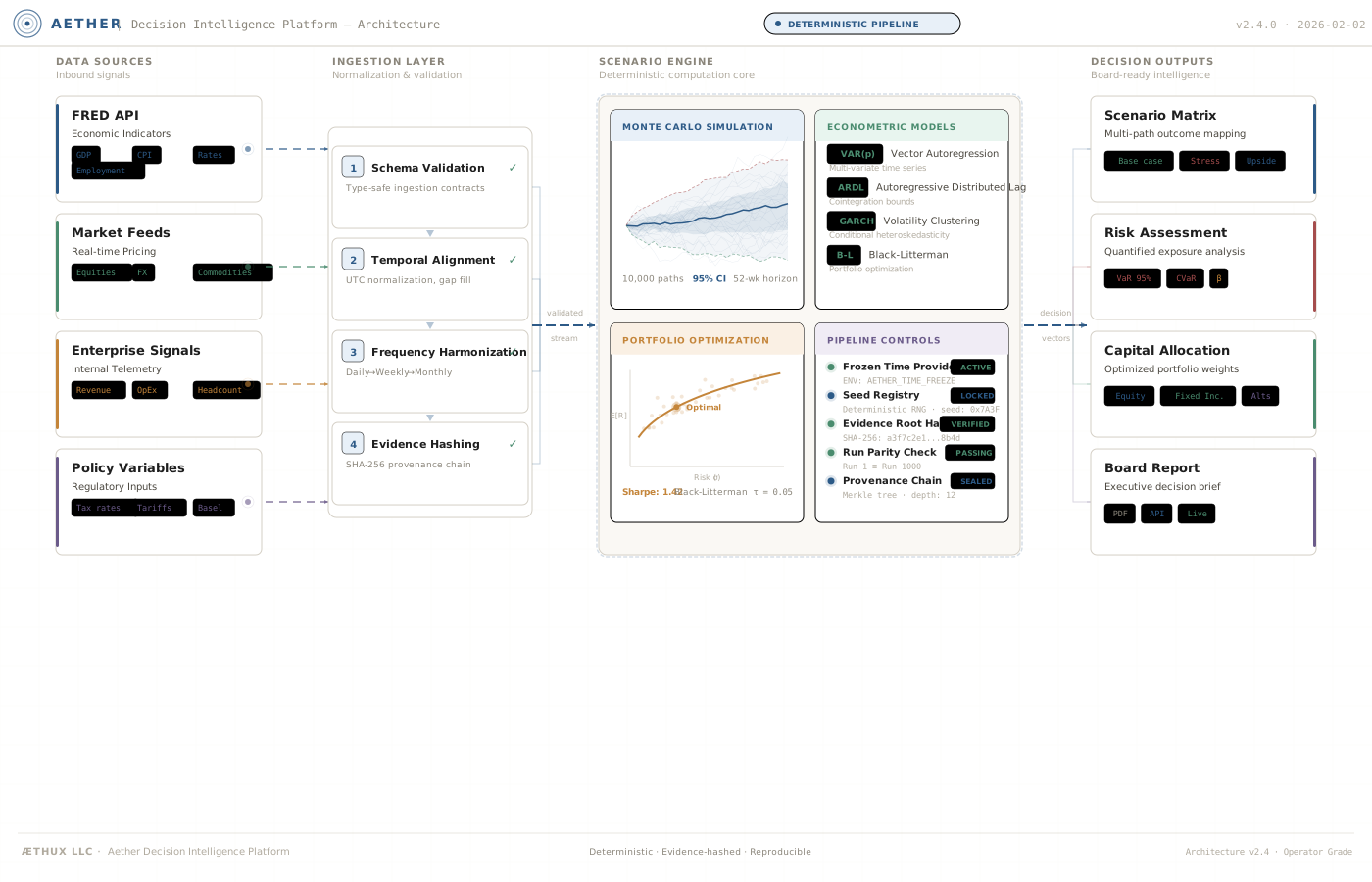
Aether ingests verified operational and economic evidence to execute 10,000+ deterministic simulations across high-dimensional risk scenarios—from interest-rate sensitivity to architectural and capital allocation arbitrage.
Deterministic simulation performs the calculation. Large language models are used only to translate those fixed results into clear, board-ready decision narratives, never to infer, optimize, or decide.
Aether does not rely on a single model or heuristic. It employs a composite solver architecture to quantify distinct classes of capital risk—from tail-event probability to macroeconomic shock propagation.
Each solver is purpose-built for a specific failure mode of enterprise strategy. All execution is deterministic, seed-pinned, and auditable.
Used to evaluate full outcome distributions across complex, multi-variable decisions. Aether executes 10,000+ deterministic iterations to surface P90, P95, and P99 tail risks that linear projections and point estimates systematically miss.
Used to update strategic probability weights as new evidence emerges. As execution data changes, Aether recalculates confidence intervals and exposure, without rewriting the strategy narrative.
Dynamic Stochastic General Equilibrium modeling is used to simulate how external shocks—interest rates, inflation regimes, policy changes—propagate through enterprise cost structures, operating leverage, and capital efficiency.
Quantify the operating expense impact of a sustained 100bps interest rate increase on variable cloud debt, committed spend, and financing-linked infrastructure contracts.
Federal yield curve data + Atlas cost and commitment models
Calculate the net yield of repatriating 30 percent of cold storage workloads from public cloud to on-premise infrastructure over a 36-month horizon, including depreciation, migration friction, and opportunity cost.
Spot market pricing + hardware depreciation schedules + Atlas workload telemetry
Simulate the operational blast radius and revenue-at-risk resulting from a four-hour critical outage at a primary API or infrastructure provider.
Atlas dependency graph + service criticality mapping + revenue attribution
Quantify the NPV loss of a 12-month delay: incremental run-rate cost, foregone savings, revenue-at-risk, and tail exposure.
Atlas cost and execution telemetry + revenue attribution + scenario assumptions (rates, demand, competitor response)
Identify which vendors control more than 10 percent of the technology stack and quantify the operational, financial, and recovery risk associated with loss, degradation, or forced renegotiation.
Atlas dependency graph + contract and spend data + service criticality and recovery assumptions
Ingress & Verification
Aether ingests data only from authenticated Atlas sensors and verified economic sources. Inputs are validated at ingestion. Unverified or synthetic data is rejected upstream.
Simulation Runtime
All computation runs in a sandboxed simulation environment with pinned seeds and immutable inputs. Identical assumptions always produce identical outputs. Execution is isolated, auditable, and reproducible by design.
Read-Only Translation
Language models are used only to explain results that have already been computed. Numbers, assumptions, and outcomes are fixed before any narrative is generated. The model reports decisions; it does not influence them.
- Federal funds rate and Treasury yield curves
- CPI, PCE, and inflation spot rates
- Real GDP and industrial production indices
- 10Y–2Y and 10Y–3M yield spreads
-Real-time Atlas dependency graph
- SAP contract and vendor ledgers
- Workday organizational structure and headcount
- Shadow IT and DNS egress telemetry
Re-run the same scenario with the same inputs and get the same outputs. Hash-verifiable. Tamper-evident. Board-ready.
Seed pinning, dependency hashes, container digests, prompt template hashes. Full reproducibility.
Every data point traced to source. Every assumption documented. Every claim verifiable.
Run any scenario again—with or without the LLM layer. Identical truth outputs guaranteed.
SHA-256 artifact hashing. Immutable evidence directories. Complete audit trail.