Best in Class

Quantify technology risk across interconnected systems.

[ about our company ]
We empower businesses to do more with less through cutting-edge AI-driven automation. Our mission is to eliminate repetitive tasks, streamline operations, and unlock human potential by integrating intelligent systems into everyday workflows.

PROBLEM

Technology decisions carry hidden financial exposure.

<subject>[background image] image of modern library (for an edtech)</subject>

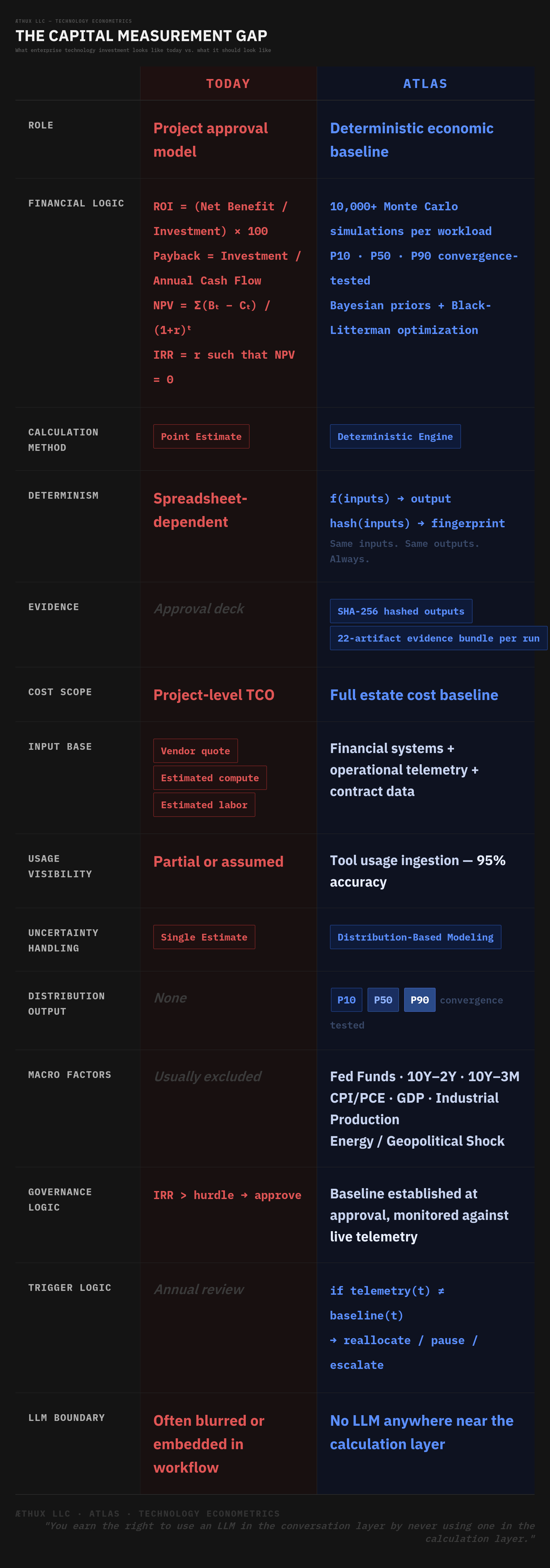
Modern enterprises sit on a fiscal fault line: technology spend is a massive capital allocation without an auditable link to revenue. Atlas and Aether close this gap. Our framework binds business strategy to technology capex through reproducible, audit-grade computation of cost, risk, and economic contribution.

The 1,300-Application Estate

The average enterprise operates ~1,300 applications and cloud services, yet formal governance typically covers fewer than 5% of them, leaving the majority of the estate unmanaged and unaudited.

The Capability Blind Spot

90–95% of AI pilots and ~70% of digital transformation programs fail to reach production due to unknown dependencies, incorrect workflows, or insufficient underlying capacity.

The Attribution Void

Between 25–40% of total IT spend cannot be attributed to a specific business unit, product line, or revenue stream, preventing true margin and ROI analysis.

The Usage Gap

30–50% of SaaS licenses show no meaningful usage over a 90-day window, leaving the P&L burdened with persistent ghost costs.

Systemic constraints in enterprise IT

Most enterprise technology tools were not designed to make financial impact explicit. They manage systems, monitor activity, or optimize isolated metrics, but they do not compute how technology behavior translates into cost, risk, or economic contribution across interconnected environments. Financial exposure remains fragmented, inferred indirectly, or opaque to decision-makers, even as technology becomes one of the largest drivers of capital allocation and enterprise value.

Integration Icon - Quantum | Webflow Template

Visibility obscures operational flow

Revenue and risk cannot be traced to technology execution. Technology spend lacks verifiable value attribution. Financial outcomes are disconnected from system behavior.

Integration Icon - Quantum | Webflow Template

Financial risk remains concealed

Enterprise technology tools were not designed to model financial exposure across dynamic, interconnected systems. Each category solves a narrow problem in isolation, and in doing so, introduces its own form of opacity.

Integration Icon - Quantum | Webflow Template

Decisions lack uncertainty modeling

Cost and FinOps platforms allocate spend, but cannot trace it through execution paths or outcomes. Architecture diagrams describe intent, not reality.

Integration Icon - Quantum | Webflow Template

Fragmentation weakens accountability

As environments scale and interconnect, these gaps compound. What is known becomes partial. What matters becomes indirect. And what remains unknown carries real financial consequence.

Deterministic resolution. Quantitative optimization.

Financial Exposure

Atlas forensically interrogates the enterprise technology stack, decomposing bundled licenses and consumption-based services into unit-level cost, dependency, and risk.

Verdict: Technology spend becomes a computable, auditable capital asset.

Technical Debt

Atlas exposes technology drift and vendor lock-in across hybrid environments, collapsing the gap between reported budgets and realized technical debt.

Verdict: Cost and risk are rendered definitive and reviewable, grounded in observed execution.

Outcomes: Technology Financial Exposure

Verified Capital Estate
A deterministic reconciliation of the General Ledger against engineering reality. Estimates are replaced with an evidence-backed capital state that makes cost, ownership, and dependency explicit and defensible.
Precomitment Simulation
Capital allocations evaluated against real operational constraints before execution. Decisions are stress-tested for cost, risk, and structural impact using evidence rather than projections.

Accelerated Diligence
Focused assessment for M&A and transformation initiatives. We surface technical debt, integration risk, and synergy constraints early, reducing discovery risk and post-commitment surprises.
Where capital decisions are computed.
Aether replaces strategy narrative with financial proof. As an unbiased fiduciary, it integrates Atlas execution data with FRED and market signals to compute how changing conditions impact technology margins. Outcomes are replayable, audit-grade, and defensible.
Learn More

Engagement Model

Integration Icon - Quantum | Webflow Template

Scope-Based Pricing

Pricing scales with the number of business units or P&L centers in scope. Engagements are defined around your specific focus, whether a single division or a broader enterprise rollout.

Integration Icon - Quantum | Webflow Template

One-Time Deployment

Deployment is a fixed-cost engagement. Instrumentation and system binding are handled end to end, delivering an operational decision engine without hourly billing or scope drift.

Integration Icon - Quantum | Webflow Template

Fixed-Cost Implementation

Focused assessment for M&A and transformation initiatives. We surface technical debt, integration risk, and synergy constraints early, reducing discovery risk and post-commitment surprises.

Let Us Run The Numbers

SCHEDULE DEMO